


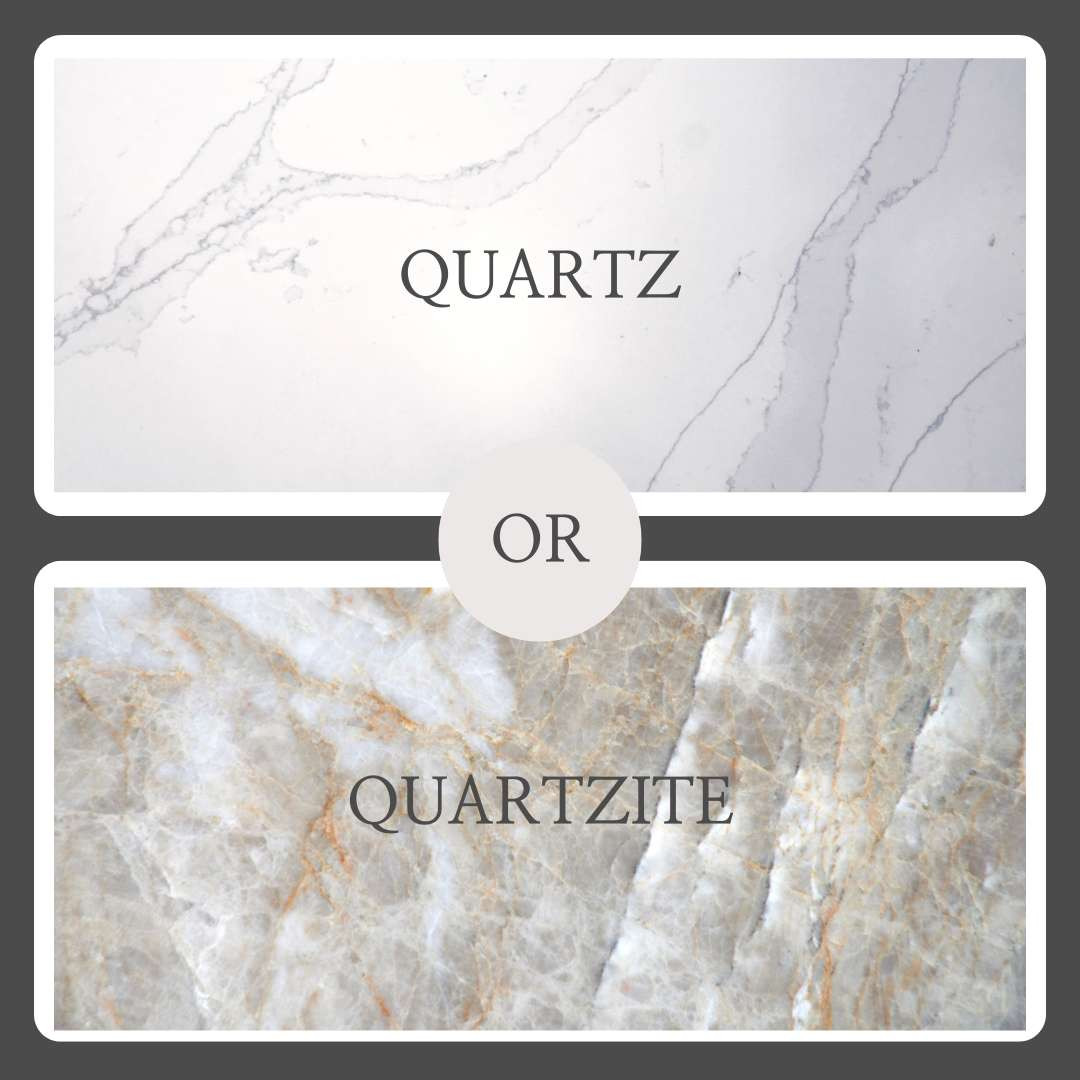
Quartz vs quartzite in Kenya is an important distinction for anyone choosing stone for kitchen countertops, bathroom vanities, islands, wall applications or other architectural surfaces. Although the names sound almost identical, quartz and quartzite are fundamentally different materials with different origins, compositions, fabrication requirements, maintenance considerations and performance characteristics.
The confusion is understandable.
Recommended Stone Solutions



Both materials contain quartz.
Both can have attractive stone-like appearances.
Both are widely associated with premium countertops.
Both can be available in white, grey, beige and other colours.
Yet they should not be treated as interchangeable.
Engineered quartz is a manufactured surface made using natural mineral aggregates combined with binders and pigments, while quartzite is a natural metamorphic rock formed through geological processes.
That distinction affects how the materials behave.
It affects how they are fabricated.
It affects how they should be maintained.
It can also affect how a buyer should evaluate quotations from different suppliers.
For architects, interior designers, property developers and homeowners in Kenya, understanding the difference before purchasing can prevent costly misunderstandings.
Maruti Mining Limited provides natural and engineered stone solutions for architectural projects. You can discover the full range of quartz surfaces when comparing options for your project.
What Is Quartz?
Engineered quartz is a manufactured stone surface produced by combining quartz-rich mineral material with binders, pigments and other components under controlled manufacturing conditions.
The term “quartz” can create confusion because quartz itself is a naturally occurring mineral.
In the countertop industry, however, “quartz” commonly refers to an engineered surface.
Manufacturers process mineral material and combine it with binding materials to create slabs with controlled dimensions, patterns and surface characteristics.
The result is a manufactured product rather than a naturally formed slab of solid quartz crystal.
This allows manufacturers to create a wide variety of visual effects.
Some engineered quartz products are designed to resemble:
- Marble
- Granite
- Concrete
- Limestone
- Other natural stones
The appearance can therefore be highly consistent from slab to slab, depending on the product range.
What Is Quartzite?
Quartzite is a natural metamorphic rock formed when quartz-rich sandstone is subjected to heat and pressure over geological time.
Unlike engineered quartz, quartzite is not manufactured as a countertop material.
It begins as a natural geological material.
Heat and pressure alter the original rock structure.
The resulting quartzite can contain a very high proportion of quartz, although its exact mineral composition varies depending on its geological origin.
Because it is natural stone, every quartzite slab can have variations in:
- Veining
- Colour
- Mineral pattern
- Grain
- Movement
- Background tone
This natural variation is one of the characteristics that attracts buyers to quartzite.
Quartz vs Quartzite in Kenya: The Fundamental Difference
The simplest distinction is that engineered quartz is manufactured while quartzite is a naturally occurring stone that has been transformed by geological processes.
A useful comparison is:
| Feature | Engineered Quartz | Quartzite |
|---|---|---|
| Origin | Manufactured | Natural |
| Main mineral component | Quartz-rich aggregate | Predominantly quartz-rich natural rock |
| Formation | Industrial manufacturing | Geological metamorphism |
| Pattern | Controlled/manufactured | Naturally variable |
| Slab consistency | Generally more predictable | Natural variation |
| Porosity | Generally low | Can vary |
| Sealing | Product-dependent | Often recommended depending on stone |
| Fabrication | Engineered-stone fabrication | Natural-stone fabrication |
| Appearance | Highly controlled | Naturally unique |
| Maintenance | Generally straightforward | Requires stone-specific care |
The exact characteristics depend on the specific product or quartzite variety.
This is why buyers should not rely on the material name alone.
Why the Names Cause So Much Confusion
The word “quartz” appears in both materials because quartz is an important mineral component, but that does not mean the two products have the same composition or manufacturing process.
Consider the terminology.
Quartz is a mineral.
Quartzite is a rock.
Engineered quartz is a manufactured composite surface containing quartz-rich material.
These are related concepts but not identical products.
A salesperson, contractor or buyer who uses the terms interchangeably can unintentionally create confusion.
For a major countertop project, the material specification should clearly identify the intended product.
Is Quartz Natural Stone?
Quartz itself is a natural mineral, but engineered quartz countertops are manufactured products rather than slabs of naturally quarried quartz.
This distinction matters when comparing engineered quartz with natural stones such as:
- Granite
- Marble
- Quartzite
- Limestone
- Travertine
Engineered quartz is manufactured to provide predictable surface characteristics.
Natural stone is quarried and processed from geological material.
Neither category is automatically “better.”
The right choice depends on the project.
Is Quartzite Natural Stone?
Yes, quartzite is a natural stone because it forms naturally through metamorphic geological processes rather than being manufactured as a countertop slab.
Its natural origin means that variation is expected.
Two slabs from the same quartzite family may not look identical.
This can be desirable when a project calls for a distinctive natural surface.
It also means buyers should inspect actual slabs rather than relying entirely on a small sample.
Appearance: Quartz Versus Quartzite
Engineered quartz offers greater control over visual consistency, while quartzite provides naturally occurring patterns and variations that can give a project a more individual character.
Engineered quartz can be particularly useful where the designer wants:
- Consistent colour
- Repeated patterns
- Predictable veining
- A controlled aesthetic
- Easier coordination between multiple areas
Quartzite can be attractive when the objective is:
- Natural variation
- Dramatic movement
- Geological character
- Unique veining
- A one-of-a-kind appearance
Neither approach is inherently superior.
It is a design decision.
Why Quartzite Can Look Like Marble
Some quartzite varieties contain dramatic veining and light backgrounds that closely resemble marble, making them attractive to buyers seeking marble-like aesthetics with different performance characteristics.
This is one reason quartzite has become increasingly interesting for premium interiors.
A quartzite slab may have:
- White backgrounds
- Grey veins
- Gold accents
- Green tones
- Dark movement
The exact appearance depends on the geological source.
Because natural variation is part of the material, slab selection is important.
Why Engineered Quartz Can Imitate Natural Stone
Modern engineered quartz manufacturing can reproduce visual patterns inspired by marble, granite and other stones, giving designers greater control over appearance.
This is particularly useful where consistency matters.
For example, a developer fitting multiple apartments may prefer a product with predictable appearance across several units.
A hospitality project may also benefit from consistent finishes.
Natural quartzite may provide more variation between slabs.
The choice depends on the design brief.
Durability Comparison
Both engineered quartz and quartzite can be durable countertop materials, but their performance characteristics differ and should be evaluated according to the intended application.
Quartzite is a hard natural stone.
Engineered quartz is also designed for demanding countertop applications.
However, durability is not a single measurement.
It includes resistance to:
- Scratching
- Impact
- Heat
- Staining
- Chemical exposure
- Wear
The relevant performance depends on the specific material.
Scratch Resistance
Quartzite is a very hard natural stone, while engineered quartz is also designed to resist everyday scratching, but neither material should be treated as completely scratch-proof.
Use appropriate cutting boards.
Avoid dragging heavy or gritty objects across the surface.
For both materials, prevention is better than repair.
The hardness of quartzite is one of its attractive characteristics.
Engineered quartz also performs well in ordinary countertop use.
But everyday care still matters.
Heat Resistance: Quartz vs Quartzite
Quartzite generally tolerates heat well as a natural stone, while engineered quartz requires greater caution around high-temperature cookware because heat can affect its resin-based components or surface system.
This is one of the most important practical differences for kitchens.
A hot pan should not be placed directly on an engineered quartz countertop.
Use:
- Trivets
- Heat-resistant pads
- Appropriate countertop protection
Quartzite can tolerate higher temperatures than many engineered quartz products, but sensible precautions remain advisable.
Heat shock can also be relevant to natural stone under extreme conditions.
Can You Put a Hot Pan on Quartz?
It is safer to assume that hot cookware should not be placed directly on engineered quartz unless the manufacturer specifically confirms the product’s heat tolerance for that use.
Even if the surface appears unaffected initially, repeated heat exposure can create problems.
Kitchen design should therefore include appropriate heat-protection practices.
A trivet is inexpensive compared with countertop replacement.
Can You Put a Hot Pan on Quartzite?
Quartzite generally has strong heat resistance because it is natural stone, but using a heat-resistant pad remains a sensible precaution for countertop protection and installation-specific reasons.
The exact behaviour depends on the stone.
A quartzite slab may also contain mineral inclusions or have been treated during fabrication.
Good practice remains important.
Stain Resistance
Engineered quartz is generally low-porosity, while quartzite porosity varies by stone and may justify sealing depending on the material and application.
This is another major distinction.
Engineered quartz is manufactured with relatively controlled absorption characteristics.
Quartzite is natural.
Its behaviour can vary.
Some quartzites may be relatively dense.
Others may absorb more readily.
The correct approach is to determine the actual stone’s characteristics.
Does Quartzite Need Sealing?
Many quartzite surfaces can benefit from appropriate sealing depending on their porosity, finish and application, but sealing requirements should be determined for the specific stone rather than assumed universally.
A suitable sealer can help reduce absorption.
However, sealing does not make quartzite maintenance-free.
You still need to:
- Clean spills promptly
- Use compatible cleaning products
- Avoid unnecessary abrasion
- Follow the recommended maintenance schedule
The correct sealer should also be selected for the specific stone.
Does Engineered Quartz Need Sealing?
Most engineered quartz countertop products are manufactured to be low-porosity and generally do not require routine sealing in the same way many natural stones do.
However, product-specific instructions should always take priority.
Different manufacturers may specify different care requirements.
This is why buyers should request the technical information for the exact product being supplied.
Maintenance Differences
Engineered quartz generally offers simpler routine maintenance, while quartzite requires natural-stone maintenance practices that may include periodic sealing and more material-specific care.
For engineered quartz, routine care usually focuses on:
- Prompt spill removal
- Soft cloths
- Appropriate cleaners
- Avoiding excessive heat
- Avoiding abrasive products
For quartzite, maintenance may additionally include:
- Sealer inspection
- Appropriate resealing where necessary
- Natural-stone-compatible cleaning
- Stain prevention
The difference is manageable when understood from the beginning.
Cleaning Quartz Countertops
Engineered quartz should generally be cleaned using products approved for the specific product, with harsh abrasives and unsuitable chemicals avoided.
For daily cleaning:
- Remove crumbs and loose dirt.
- Wipe the surface.
- Use an appropriate cleaner where required.
- Rinse or wipe away residue according to product instructions.
- Dry the surface if necessary.
Avoid assuming that every household chemical is compatible.
A strong chemical is not automatically a better cleaner.
Cleaning Quartzite Countertops
Quartzite should be cleaned as natural stone, using compatible products and avoiding acidic or abrasive cleaners that could affect the stone or its finish.
Avoid casually using:
- Vinegar
- Lemon-based cleaners
- Strong acidic descalers
- Abrasive powders
Instead, use a cleaner appropriate for natural stone.
For additional guidance, visit our Knowledge Base for expert insights.
Quartz vs Quartzite in Kenya: Cost Considerations
The final cost of quartz or quartzite depends on more than the slab price, with fabrication, thickness, edge profiles, installation, wastage and project complexity all influencing the final quotation.
A simple price comparison can therefore be misleading.
Consider:
- Material cost
- Slab dimensions
- Thickness
- Number of slabs
- Cutting requirements
- Sink cut-outs
- Hob cut-outs
- Edge profiles
- Splashbacks
- Transportation
- Installation
- Wastage
- Sealing requirements
Two projects using the same material can have very different final costs.
Why Slab Size Matters
Large islands and complex countertop layouts can increase material requirements and fabrication complexity regardless of whether quartz or quartzite is selected.
A kitchen with a large island may require careful slab planning.
Natural quartzite can have dramatic patterns that also need to be matched across joins.
Engineered quartz may provide more predictable pattern repetition.
The fabricator should therefore review the kitchen drawings before the final material quantity is determined.
Quartzite and Pattern Matching
Natural quartzite can require careful slab selection and layout planning when strong veining needs to flow across joins, which can increase fabrication complexity.
This is particularly important for:
- Waterfall islands
- Bookmatched walls
- Long countertops
- Large splashbacks
A slab should not be selected only from a small sample.
Where the visual pattern is important, the actual slab should be reviewed.
Quartz and Pattern Consistency
Engineered quartz can offer greater pattern consistency across multiple pieces, which can simplify coordination in large residential or commercial developments.
This can be useful for:
- Apartment developments
- Hotels
- Offices
- Restaurants
- Retail spaces
Consistency can reduce visual variation.
However, some buyers prefer natural variation.
The choice should reflect the project’s design objective.
Fabrication Differences
Both materials require professional fabrication, but natural quartzite must be handled as natural stone while engineered quartz has product-specific fabrication requirements.
Fabrication can include:
- Measuring
- Cutting
- Edge profiling
- Sink cut-outs
- Hob cut-outs
- Polishing
- Joining
- Installation
The fabricator should understand the selected material.
Incorrect fabrication can damage an otherwise high-quality slab.
Edge Profiles
The edge profile can influence both appearance and durability, so the selected profile should be appropriate for the material and application.
Common approaches include:
- Straight edge
- Eased edge
- Bullnose
- Bevel
- Custom profiles
The correct choice depends on the design.
Complex profiles may require additional fabrication.
Sink Cut-Outs
Sink and hob cut-outs require accurate measurement and proper fabrication because poorly executed openings can create stress concentrations or unattractive finishes.
This is particularly important for large sinks.
The fabricator should coordinate with the:
- Cabinetmaker
- Plumber
- Appliance installer
- Interior designer
- Contractor
before cutting begins.
Quartz vs Quartzite for Kitchen Islands
Both materials can work well for kitchen islands, but the choice should reflect heat exposure, maintenance expectations, design preferences and the specific product’s technical characteristics.
Choose engineered quartz when:
- Consistency is important.
- Low routine maintenance is preferred.
- The selected product meets the design requirements.
- Heat exposure can be controlled.
Consider quartzite when:
- Natural stone is preferred.
- Unique veining is important.
- High heat resistance is desirable.
- The project can accommodate natural variation.
- Appropriate stone maintenance is acceptable.
Quartz vs Quartzite for Bathroom Vanities
Both quartz and quartzite can be suitable for bathroom applications when correctly specified, fabricated and installed.
Consider:
- Water exposure
- Cleaning chemicals
- Basin cut-outs
- Splashbacks
- Cabinet support
- Sealing requirements
Bathroom cleaning products can be surprisingly aggressive.
Material compatibility remains important.
Quartz vs Quartzite for Outdoor Applications
Outdoor use requires additional consideration of sunlight, weather exposure, temperature variation and manufacturer recommendations, so a countertop product should not be assumed suitable simply because it performs well indoors.
Before specifying either material outdoors, confirm its suitability for the exact environmental conditions.
This is particularly important in Kenya, where outdoor applications can experience strong sunlight and significant temperature variation.
The product’s technical documentation should guide the decision.
Quartz vs Quartzite for Commercial Projects
Commercial environments require a broader assessment because high traffic, maintenance routines, cleaning chemicals and replacement requirements can influence the practical suitability of the material.
For a hotel, restaurant or office project, consider:
- Expected traffic
- Cleaning frequency
- Maintenance staff
- Heat exposure
- Design consistency
- Repair requirements
- Replacement availability
A material that works well in a private kitchen may not be the ideal choice for a heavily used commercial counter.
Natural Variation in Quartzite
Natural variation is one of quartzite’s greatest design advantages, but it also means buyers should accept that the final installation may differ from a small sample.
The slab may contain:
- Veins
- Mineral patches
- Colour shifts
- Natural movement
These are not manufacturing defects.
They are part of the geological character of the stone.
For clients who want a perfectly uniform surface, engineered quartz may be more appropriate.
Colour Matching in Engineered Quartz
Engineered quartz provides more predictable visual characteristics, although batch and production variation can still occur, making final product confirmation important.
For large projects, verify the selected colour and product batch before fabrication.
Do not rely exclusively on an online image.
Lighting can also influence how the surface appears.
Why Samples Can Be Misleading
Small samples cannot always represent the full appearance of a large slab, particularly when the material has dramatic veining or natural variation.
This applies particularly to quartzite.
A small sample might show:
- Mostly white
while the full slab contains:
- Large grey veins
- Dark mineral areas
- Strong movement
For major projects, slab inspection is highly recommended.
How to Specify Quartz Correctly
A professional specification should identify the exact engineered quartz product, colour, thickness, finish and relevant technical requirements rather than simply stating “quartz.”
A good specification can include:
- Manufacturer
- Product range
- Colour
- Slab thickness
- Finish
- Edge profile
- Fabrication requirements
- Installation requirements
- Warranty documentation
- Maintenance instructions
This reduces the risk of substitutions.
How to Specify Quartzite Correctly
A quartzite specification should identify the selected stone, desired colour range, slab characteristics, thickness, finish and acceptable natural variation.
It should also clarify:
- Sealing requirements
- Fabrication
- Pattern matching
- Sample approval
- Slab approval
- Installation
- Maintenance
Because natural variation is unavoidable, the specification should define what the client considers acceptable.
Why Technical Documentation Matters
Material names alone do not provide enough information for a major architectural project, so technical documentation should be reviewed before final approval.
For engineered quartz, request product information.
For quartzite, assess the actual stone.
This helps architects and developers make decisions based on evidence rather than marketing terminology.
Quartz vs Quartzite in Kenya: Which Is Better?
There is no universal winner between quartz and quartzite; the better material depends on the project’s priorities, including appearance, heat exposure, maintenance, natural variation, budget and design intent.
Engineered quartz may be preferable when the priority is:
- Consistency
- Low routine maintenance
- Controlled appearance
- Broad colour selection
Quartzite may be preferable when the priority is:
- Natural stone
- Unique veining
- Natural geological character
- Strong heat resistance
Both can create excellent results when correctly specified.
Common Buying Mistakes
Many problems arise because buyers compare materials using only colour and price while overlooking composition, maintenance, fabrication and technical performance.
Avoid these mistakes:
Mistake 1: Assuming the names mean the same thing
Quartz and quartzite are different materials.
Mistake 2: Comparing only slab prices
Fabrication and installation also matter.
Mistake 3: Ignoring heat exposure
Kitchen users should understand the material’s heat limitations.
Mistake 4: Assuming quartzite is maintenance-free
Natural stone may require sealing and appropriate care.
Mistake 5: Treating engineered quartz like natural stone
Its resin-based composition creates different considerations.
Mistake 6: Choosing from a tiny sample
Inspect actual slabs when visual variation matters.
Mistake 7: Accepting vague specifications
The exact material should be clearly identified.
Questions to Ask Your Stone Supplier
A good supplier should be able to explain exactly what material is being offered and how it should be fabricated, installed and maintained.
Ask:
- Is this engineered quartz or natural quartzite?
- Who is the manufacturer or stone source?
- What is the slab thickness?
- What finish is available?
- Does the material require sealing?
- What cleaning products are recommended?
- What are the heat limitations?
- How should the slab be fabricated?
- How should joins be positioned?
- What warranty or technical documentation is provided?
These questions can prevent expensive misunderstandings.
Why Supplier Expertise Matters
Stone selection is only the first stage; accurate fabrication, installation and aftercare are equally important to achieving the expected result.
A premium slab can still perform poorly if:
- Measurements are inaccurate.
- Supports are inadequate.
- Cut-outs are poorly positioned.
- Joins are badly executed.
- The surface is mishandled.
- Maintenance instructions are ignored.
The supplier or fabricator should therefore be part of the technical decision.
You can learn more about Maruti Mining Limited and the company’s approach to stone solutions before beginning a project.
Quartz vs Quartzite: A Practical Decision Framework
The easiest way to choose between quartz and quartzite is to start with the application’s demands and then compare the materials against those requirements.
Ask:
Do you want a highly controlled appearance?
Engineered quartz may be attractive.
Do you want genuine natural stone?
Quartzite may be preferable.
Is high heat exposure expected?
Quartzite may offer an advantage, while engineered quartz requires greater caution.
Is low routine maintenance important?
Engineered quartz can be convenient.
Do you want dramatic natural veining?
Quartzite can provide unique geological patterns.
Is consistency across multiple units important?
Engineered quartz may simplify visual coordination.
Is natural variation part of the design?
Quartzite may be ideal.
Making the Final Selection
The best material is the one that meets the project’s technical, aesthetic and maintenance requirements rather than the one with the most impressive marketing description.
Before approving the final material, consider:
- Application
- Traffic
- Heat
- Water
- Cleaning
- Design
- Budget
- Fabrication
- Installation
- Long-term maintenance
Then compare the actual products.
Not merely the material names.
Final Guide to Quartz vs Quartzite in Kenya
Quartz and quartzite may have similar names, but they represent fundamentally different material categories, and understanding that difference is essential before purchasing a countertop or architectural surface.
Engineered quartz is manufactured.
Quartzite is natural stone.
Engineered quartz offers controlled appearance, predictable manufacturing characteristics and relatively straightforward routine maintenance.
Quartzite offers natural geological character, unique variation and strong performance characteristics associated with quartz-rich natural stone.
Neither should automatically be considered the superior choice.
The right selection depends on the project.
For a modern residential kitchen where consistent colour and low routine maintenance are priorities, engineered quartz can be a practical choice.
For a luxury kitchen where dramatic natural veining and genuine stone character are central to the design, quartzite can be compelling.
For a commercial development, consistency, maintenance and fabrication requirements may influence the decision.
For a high-heat application, quartzite may deserve particular consideration.
For any project, however, the exact product matters.
Do not buy solely because a salesperson says the material is “quartz.”
Ask whether it is engineered quartz or natural quartzite.
Request technical information.
Inspect the actual slab.
Understand the maintenance requirements.
Confirm the fabrication process.
Discuss heat exposure.
Clarify sealing requirements.
And ensure the quotation identifies the material accurately.
This is particularly important in Kenya’s growing residential, hospitality, commercial and property-development sectors, where premium stone surfaces are increasingly being incorporated into kitchens, bathrooms, reception areas, islands and feature walls.
A well-selected stone can contribute significantly to the appearance and functionality of a space.
A poorly understood specification can create unnecessary maintenance problems or disappointment later.
The best purchasing decision is therefore an informed one.
Quartz is not quartzite.
The similar names should never replace a proper technical comparison.
If you are evaluating materials for a current project, explore Maruti Mining’s quartz collection or explore our marble and natural stone range to compare available options. You can also contact our team for project consultation when you need assistance with material selection, fabrication or installation.
You May Also Like


Bring Your Vision to Life in Stone
Imagine a space defined by elegance, durability, and timeless beauty. At Maruti Mining Limited, we transform your vision into reality with the finest selection of granite, marble, and quartz, backed by expert fabrication and installation.
Contact our team for a consultation and let’s create a legacy set in stone.
CUSTOM FABRICATION & INSTALLATION ACROSS EAST AFRICA
✔ Premium Collection of Over 80 Stone Varieties
✔ Expert Cutting, Polishing & Installation
✔ Free Project Consultation & Quote
✔ Serving Kenya (Nairobi, Karen, Mombasa), Uganda, Tanzania & beyond.
Request Your Free Consultation:
Maruti Mining Limited
Email: [email protected]
Phone: +254 736 701 174 | +254 728 789 164 | +254 733 519 836
Visit Us: Nairobi, Kenya
Website: https://marutimining.com/

Leave a Reply