



Office desk tops in stone can create a highly durable, sophisticated working surface, but they must be engineered around span, weight, support, thickness and service requirements. Cable cut-outs, equipment loads and installation access should be considered before the stone is fabricated.
A stone desk top is very different from a stone kitchen counter.
Recommended Stone Solutions
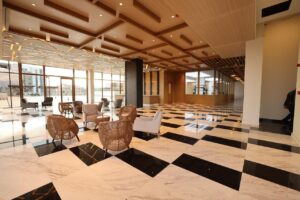
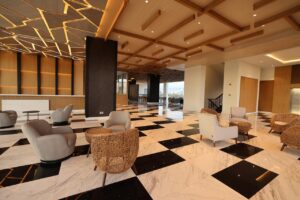
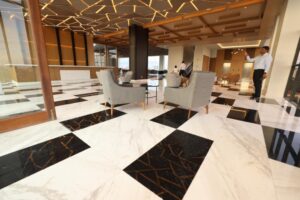
The appearance may be equally impressive, but the engineering requirements can be more demanding because office furniture often incorporates long unsupported spans, computer equipment, monitor arms, cable-management systems and integrated storage.
A large executive desk may require a substantial stone surface supported by a relatively minimal base.
A reception desk may combine stone with timber, metal, glass and concealed services.
A boardroom table may have an exceptionally large top with multiple cable-management points.
These applications require more than simply selecting an attractive slab.
The stone must be specified alongside the furniture structure.
For architects, interior designers, contractors and office developers, this means considering the complete assembly before fabrication begins.
Stone selection, dimensions, thickness, edge treatment, support spacing, cut-outs, access points and installation procedures should all work together.
Explore Maruti Mining’s completed stone projects for examples of how stone can be incorporated into architectural and commercial interiors.
Why Choose Stone for Office Desk Tops?
Stone office desk tops combine visual permanence with a substantial, premium appearance that can strengthen the character of executive offices, boardrooms, reception areas and corporate workspaces.
Stone communicates solidity.
It can make a reception counter feel permanent and authoritative.
It can give an executive office a sophisticated architectural character.
It can make a boardroom table become a focal point rather than simply another piece of furniture.
Suitable stone options include:
- Granite
- Marble
- Quartz
- Quartzite
- Other selected natural stones
The right material depends on the intended application.
Granite Office Desk Tops
Granite is an excellent option for office desk tops where durability, natural variation and resistance to everyday wear are important considerations.
Granite can work particularly well for:
- Executive desks
- Reception counters
- Boardroom tables
- Meeting tables
- Credenzas
- Side consoles
Its mineral structure produces a broad range of natural colours and patterns.
Some granites provide subtle backgrounds.
Others offer dramatic movement.
For commercial environments, the actual slab should be reviewed where appearance consistency matters.
Explore Maruti Mining’s granite range when comparing natural-stone options for office furniture.
Marble Office Desk Tops
Marble can create an exceptionally refined office desk surface, particularly in executive offices, boardrooms, hotels and premium reception areas where visual impact is a major design objective.
Its natural veining can make each desk unique.
A dramatic marble can become the primary feature of a reception desk.
A restrained marble can provide sophistication without dominating the room.
However, marble requires greater awareness of:
- Acidic substances
- Scratching
- Staining
- Surface finish
- Sealing
- Maintenance
For demanding commercial environments, material selection should therefore consider both appearance and expected usage.
Learn more about marble options before specifying a marble office desk.
Quartz Office Desk Tops
Engineered quartz can provide a controlled, contemporary appearance with relatively straightforward routine maintenance, making it suitable for many modern office environments.
One advantage of engineered quartz is consistency.
If an office project requires several desks with a similar appearance, a manufactured material can provide greater uniformity than many natural stones.
Quartz can be used for:
- Reception desks
- Executive desks
- Meeting tables
- Work counters
- Consultation desks
However, excessive heat should be avoided, and the manufacturer’s technical requirements should always be followed.
Discover Maruti Mining’s quartz surfaces when comparing engineered stone options.
1. The Span of a Stone Desk Top
Span is one of the most important structural considerations because a long stone top cannot simply be treated like a thin timber board supported only at its ends.
Stone has substantial weight and can behave differently from flexible furniture materials.
A long top may require:
- Intermediate supports
- A reinforced frame
- Steel substructure
- Additional cabinet support
- Strategically positioned legs
The correct support arrangement depends on:
- Stone type
- Thickness
- Desk dimensions
- Cut-outs
- Overhang
- Base structure
- Expected loading
There is no universal safe span that applies to every stone desk.
The complete design must be assessed.
Why Long Spans Require Planning
A long unsupported stone surface can experience stresses that increase the risk of cracking, particularly when combined with heavy equipment, impact or poorly positioned supports.
The problem is not necessarily the stone itself.
It may be the relationship between the stone and the supporting structure.
For example, a large desk with a substantial overhang may place significant stress near the support points.
A properly designed frame can distribute those loads.
Support Under Stone Desk Tops
A stone desk top should have a stable and appropriately engineered support structure that distributes its weight without creating concentrated stress points.
Support may come from:
- Cabinets
- Pedestals
- Steel frames
- Timber structures
- Metal legs
- Continuous subframes
The support should be level.
Uneven support can create stress within the slab.
Why Level Support Matters
Stone is strong but relatively rigid, so an uneven base can force the slab to accommodate stresses that a more flexible furniture material might tolerate.
Before installation, the support structure should be checked for:
- Level
- Alignment
- Stability
- Deflection
- Fixing quality
A perfectly fabricated stone top cannot compensate for a poorly constructed base.
2. Understanding Stone Desk Top Weight
Stone is substantially heavier than many conventional desk materials, so weight must be considered when designing the frame, supports, transport method and installation process.
The final weight depends on:
- Length
- Width
- Thickness
- Material density
- Cut-outs
- Number of pieces
A large stone desk can therefore become a significant structural load.
This affects not only the furniture base but also transport and installation.
Weight and Desk Legs
Desk legs and pedestals must be designed to support the total stone load without excessive movement or instability.
A lightweight decorative frame may look attractive but may not be appropriate for a substantial stone slab.
The base should be selected for engineering performance as well as appearance.
Weight and Office Flooring
Large stone furniture should also be considered in relation to the floor and the distribution of load through the furniture supports.
This becomes particularly relevant for:
- Large boardroom tables
- Reception counters
- Large executive desks
- Cantilevered counters
The load is not distributed evenly across the entire surface.
It is transferred through specific support points.
3. Stone Desk Top Thickness
Thickness influences the visual appearance, weight, structural behaviour and fabrication requirements of a stone desk top.
A thick stone top creates a substantial architectural appearance.
A thinner profile can appear more contemporary and lightweight.
However, thinner does not automatically mean better.
The correct thickness depends on the complete furniture design.
Thick Stone Desk Tops
Thicker tops can create an impressive executive appearance while providing substantial edge profiles and visual mass.
They can work particularly well in:
- Executive offices
- Boardrooms
- Premium reception areas
The additional weight must be incorporated into the support design.
Thin Stone Desk Tops
Thin stone profiles can achieve a minimalist appearance, but they require careful consideration of support, fabrication and cut-out placement.
A thin slab with large openings or long unsupported sections may require additional reinforcement.
The visual objective should therefore be balanced against structural requirements.
4. Cable Cut-Outs in Stone Desk Tops
Cable cut-outs should be planned before fabrication because drilling or cutting through stone changes the geometry of the slab and requires precise positioning.
Modern offices depend on:
- Power cables
- Monitor cables
- Network connections
- USB connections
- Charging systems
- HDMI cables
- Data connections
A desk without appropriate cable management can quickly become cluttered.
Stone can accommodate cable openings, but the position and dimensions should be confirmed before cutting.
Common Cable Cut-Out Locations
Cable openings are usually positioned according to the location of monitors, power modules and the desk’s intended working arrangement.
Common locations include:
- Behind monitor stands
- Along the rear edge
- Near the centre of a boardroom table
- Beside integrated power modules
- At designated workstation positions
The exact location should be established from the furniture and electrical drawings.
Why Cable Cut-Outs Should Not Be Added Later
Adding an unplanned opening after fabrication can create unnecessary risks, particularly if the cut-out is positioned too close to an edge, corner or existing opening.
The fabricator should know:
- Hole diameter
- Exact position
- Number of openings
- Required cover
- Cable-management hardware
- Edge clearance
This information should be approved before cutting.
Cable Grommets and Stone
A cable grommet can provide a neat transition between the stone surface and the electrical or data system, but the grommet dimensions must be compatible with the stone opening.
Do not assume every standard grommet will fit.
The hardware should be selected before fabrication.
Then the stone opening can be cut to the correct specification.
Cut-Outs Near Stone Edges
Cut-outs placed too close to an edge can create vulnerable sections, so adequate material should remain around openings to maintain the integrity of the slab.
This is particularly important with:
- Thin slabs
- Large openings
- Multiple adjacent openings
- Corner cut-outs
The exact minimum clearance should be determined according to the stone and fabrication design rather than applying an arbitrary number.
Multiple Cable Cut-Outs
Multiple openings should be coordinated carefully so they do not create a weak line across the desk top.
For boardroom tables, several power modules may be required.
Rather than placing openings wherever convenient, consider the entire layout.
A coordinated pattern can provide:
- Better appearance
- Better structural distribution
- Easier installation
- Cleaner cable management
5. Edge Profiles for Office Desk Tops
The edge profile affects both the appearance and user experience of a stone desk, particularly because office workers may rest their arms against the edge for hours at a time.
Possible profiles include:
- Eased edge
- Pencil round
- Bevel
- Bullnose
- Straight polished edge
- Custom profiles
For a workstation, a softened edge can improve comfort.
For an executive desk, a more substantial profile may reinforce the design.
Why Sharp Edges Should Be Avoided
A sharp stone edge can be uncomfortable during prolonged use and may create an unnecessary impact hazard.
An eased or slightly rounded edge is often a practical choice.
The exact profile should be selected according to:
- Desk use
- Stone type
- Thickness
- Design style
6. Desk Overhangs
Stone overhangs require careful planning because unsupported projection increases the stress placed on the slab and its support structure.
Overhangs can create elegant furniture designs.
They can make a desk appear to float.
However, the larger the overhang, the more carefully the support must be engineered.
Do not treat decorative overhangs as purely aesthetic decisions.
Cantilevered Stone Desks
Cantilevered designs require particularly careful structural engineering because the stone is supported in a way that creates additional bending forces.
A steel frame or concealed support system may be necessary.
The stone itself should not be expected to carry a structural design that has not been properly engineered.
7. Reception Desks in Stone
Stone reception desks can create a powerful first impression because they combine architectural permanence with a premium material finish.
Reception desks often incorporate:
- Stone counters
- Vertical stone panels
- Timber
- Metal
- Glass
- Lighting
- Branding
- Cable systems
This makes them more complex than ordinary desks.
The stone should therefore be coordinated with the complete reception design.
Reception Counter Height
The height of a reception desk should reflect its function, accessibility requirements, user interaction and whether the design includes seated or standing work positions.
A reception area may include:
- Visitor-facing counter
- Staff work surface
- Lower accessible section
- Storage
- Cable management
- Equipment areas
These requirements should be established before stone fabrication.
Stone Faced Reception Desks
Stone can be used not only as the horizontal counter but also as a vertical facing material to create a more substantial architectural effect.
For example, a reception desk may use matching stone on:
- Front fascia
- Countertop
- Side panels
- Feature wall
This can create a continuous visual language.
Stone Boardroom Tables
A large stone boardroom table can become the centrepiece of a corporate meeting room, but its size and weight make structural planning particularly important.
A boardroom table may require:
- Long spans
- Multiple cable openings
- Power modules
- Large support frames
- Precise slab alignment
Natural stone selection becomes particularly important because a large uninterrupted surface makes pattern and veining highly visible.
Bookmatching Stone on Boardroom Tables
Bookmatching can create a dramatic symmetrical appearance when two or more slabs are positioned so their natural patterns mirror each other.
This is especially effective with strongly veined marble.
However, bookmatching requires additional planning.
The slabs must be selected and cut specifically for the intended arrangement.
Stone Executive Desks
An executive desk provides an opportunity to use premium stone as a statement material while combining it with timber, metal or integrated storage.
A large executive desk can feature:
- Stone work surface
- Leather or timber details
- Integrated cable management
- Concealed storage
- Custom edge profiles
The stone should remain visually connected to the room’s wider design.
Stone Desk Tops and Monitor Arms
Monitor arms can create concentrated loads at specific points, so their mounting position should be considered before finalising the stone design.
A clamp attached directly to a stone edge may not be appropriate without proper consideration.
The designer should identify:
- Monitor-arm location
- Clamp type
- Mounting pressure
- Required reinforcement
- Cable route
A dedicated mounting solution may be preferable.
Heavy Office Equipment
Printers, monitors, desktop computers and other equipment can create concentrated loads that should be considered when designing the desk structure.
The desk should not be treated as though the load is evenly distributed.
Consider where equipment will be placed.
A large printer positioned near an unsupported section can behave differently from lightweight stationery.
Stone Desk Tops and Electrical Integration
Electrical planning should take place alongside stone fabrication because power modules and cable routes often require openings, recesses or concealed pathways.
Coordination should include:
- Electrical contractor
- Furniture designer
- Stone fabricator
- Interior designer
- Contractor
Late changes create unnecessary complications.
Stone Desk Top Seams
Large desk tops may require more than one piece of stone, making seam position and appearance important design considerations.
Seams should be:
- Properly aligned
- Supported
- Carefully fabricated
- Finished appropriately
The location should be coordinated with the desk design.
Seam Visibility
Natural stone seams cannot always be made invisible, but careful planning can make them less visually intrusive.
Consider positioning seams:
- Away from primary viewing areas
- Away from major cable openings
- Along natural design divisions
- In visually appropriate locations
The actual slab pattern should influence the final layout.
Stone Desk Top Installation
Installation should begin only after the supporting furniture structure is complete, stable and properly aligned.
Before placing the stone, check:
- Level
- Support
- Dimensions
- Cut-outs
- Cable openings
- Edge clearances
- Access
Once installed, the stone should be inspected for movement or stress.
Transporting Large Stone Desk Tops
Large stone pieces require controlled transportation and handling because corners, edges and cut-outs can be vulnerable during movement.
The installation team should plan:
- Access routes
- Door widths
- Staircases
- Lifts
- Turning spaces
- Handling equipment
A large slab that fits inside the office may still be impossible to move through the building without proper planning.
Office Building Access
Building access should be checked before fabrication, particularly for large boardroom tables and reception counters.
Consider:
- Lift dimensions
- Corridor widths
- Door openings
- Staircases
- Loading bays
This can prevent a costly situation where the finished stone cannot be moved into position.
Protecting Stone During Installation
Stone should be protected from construction activity because dust, tools, adhesives and impact can damage an otherwise finished surface.
During installation:
- Protect edges
- Keep tools away from polished surfaces
- Prevent construction debris from accumulating
- Avoid dragging equipment across the stone
- Cover finished surfaces appropriately
Final cleaning should take place after surrounding construction work is sufficiently complete.
Maintaining Stone Office Desk Tops
Routine maintenance is straightforward when the correct cleaning products and protective habits are used consistently.
Daily care should focus on:
- Dust removal
- Prompt spill cleaning
- Soft cloths
- Coasters
- Avoiding abrasive products
For natural stone, sealing may be appropriate depending on the material.
For engineered quartz, follow the manufacturer’s maintenance requirements.
Marble Desk Maintenance
Marble desk tops should receive particular attention because acidic drinks and unsuitable cleaning products can etch the surface.
Keep:
- Coasters
- Suitable cleaning products
- Soft cloths
readily available.
Avoid:
- Vinegar
- Lemon-based cleaners
- Abrasive powders
- Harsh chemicals
Granite Desk Maintenance
Granite generally provides a practical office surface, but regular cleaning and appropriate sealing can help maintain its appearance.
Wipe spills promptly.
Use appropriate cleaners.
Avoid dragging heavy equipment.
Protect the surface from unnecessary impact.
Quartz Desk Maintenance
Quartz requires relatively simple daily cleaning, but excessive heat and unsuitable chemicals should still be avoided.
Use a soft cloth and appropriate cleaner.
Do not place extremely hot objects directly on the surface.
Follow the manufacturer’s specific maintenance instructions.
Choosing Between Granite, Marble and Quartz
The best stone for an office desk depends on the balance between appearance, maintenance, usage, consistency and budget rather than one material being universally superior.
| Material | Main Advantage | Main Consideration |
|---|---|---|
| Granite | Durable natural stone | Natural variation |
| Marble | Exceptional visual character | More sensitive to acids and scratching |
| Quartz | Consistent contemporary appearance | Heat protection required |
| Quartzite | Natural stone with strong performance characteristics | Slab selection and cost |
The final decision should reflect the actual office environment.
Office Desk Tops and Corporate Branding
Stone can support corporate identity by creating a consistent material language across reception counters, executive offices and meeting rooms.
For example, a company may use one stone family across:
- Reception
- Boardroom
- Executive offices
- Breakout areas
This can create a coherent visual identity.
Using Stone in Corporate Reception Areas
Reception is one of the strongest applications for premium stone because visitors interact with the surface immediately upon entering an office.
A carefully designed stone reception desk can communicate:
- Quality
- Permanence
- Professionalism
- Attention to detail
The stone can also coordinate with flooring and wall finishes.
Stone Desk Tops and Real Estate Value
High-quality stone furniture can contribute to the perceived quality of an office interior, particularly in premium commercial, hospitality and executive environments.
The value comes from the complete design rather than the stone alone.
Good fabrication.
Proper installation.
Appropriate proportions.
Coordinated materials.
These factors determine whether the final result looks genuinely premium.
How to Specify Office Desk Tops
A professional stone specification should identify the material, slab, dimensions, thickness, finish, edge profile, support structure, cut-outs and installation requirements before fabrication begins.
A useful specification should include:
- Stone type
- Colour or slab reference
- Slab approval requirements
- Finished dimensions
- Thickness
- Surface finish
- Edge profile
- Corner treatment
- Cable cut-out dimensions
- Cable cut-out locations
- Support arrangement
- Overhang dimensions
- Seam locations
- Installation requirements
- Maintenance instructions
This level of detail reduces misunderstandings between the designer, contractor and fabricator.
Common Office Desk Top Mistakes
Many stone desk problems can be prevented by addressing engineering and service requirements before the slab reaches the fabrication stage.
Mistake 1: Ignoring the Weight
A stone top requires a suitable support structure.
Mistake 2: Designing Long Unsupported Spans
Long spans require careful structural consideration.
Mistake 3: Adding Cable Holes Too Late
Cut-outs should be incorporated into the approved fabrication drawings.
Mistake 4: Forgetting Monitor Mounts
Equipment mounting points can create concentrated loads.
Mistake 5: Using a Weak Base
A beautiful stone top cannot compensate for inadequate support.
Mistake 6: Ignoring Building Access
Large stone pieces need an installation route.
Mistake 7: Choosing Stone Without Considering Maintenance
A visually beautiful material must still suit the office environment.
Office Desk Tops: The Complete Design Approach
The best office desk tops are designed as complete systems in which the stone, furniture base, cable management, equipment, dimensions and installation method are considered together.
Start with the office function.
Determine the desk dimensions.
Identify equipment.
Map cable requirements.
Choose the stone.
Review the actual slab where necessary.
Determine thickness.
Design the support structure.
Confirm cut-outs.
Specify edge profiles.
Check building access.
Then proceed with fabrication.
This approach reduces costly modifications later.
Final Guide to Office Desk Tops
Stone office desk tops can provide decades of visual appeal when properly specified, fabricated, supported and maintained. The critical considerations are not simply colour and pattern but also span, weight, thickness, support, cable cut-outs, equipment loads and installation access.
Granite provides a durable natural option.
Marble offers exceptional visual character for executive and luxury environments.
Quartz provides consistency and a contemporary appearance.
Quartzite offers another natural-stone alternative where its specific properties suit the project.
Regardless of material, the stone should never be designed in isolation from the furniture structure.
A long desk needs appropriate support.
A heavy top needs an engineered base.
A boardroom table needs coordinated cable management.
A reception desk needs careful integration of services and branding.
A monitor arm needs a suitable mounting strategy.
And every large stone piece needs an appropriate transport and installation plan.
The strongest office furniture projects begin with detailed coordination between the architect, interior designer, furniture manufacturer, electrical contractor, stone fabricator and installation team.
For architects, developers, contractors and business owners planning premium office interiors, visit Maruti Mining’s Knowledge Base for additional stone guidance or contact the Maruti Mining team for a project consultation.
You May Also Like


Bring Your Vision to Life in Stone
Imagine a space defined by elegance, durability, and timeless beauty. At Maruti Mining Limited, we transform your vision into reality with the finest selection of granite, marble, and quartz, backed by expert fabrication and installation.
Contact our team for a consultation and let’s create a legacy set in stone.
CUSTOM FABRICATION & INSTALLATION ACROSS EAST AFRICA
✔ Premium Collection of Over 80 Stone Varieties
✔ Expert Cutting, Polishing & Installation
✔ Free Project Consultation & Quote
✔ Serving Kenya (Nairobi, Karen, Mombasa), Uganda, Tanzania & beyond.
Request Your Free Consultation:
Maruti Mining Limited
Email: [email protected]
Phone: +254 736 701 174 | +254 728 789 164 | +254 733 519 836
Visit Us: Nairobi, Kenya
Website: https://marutimining.com/

Leave a Reply