


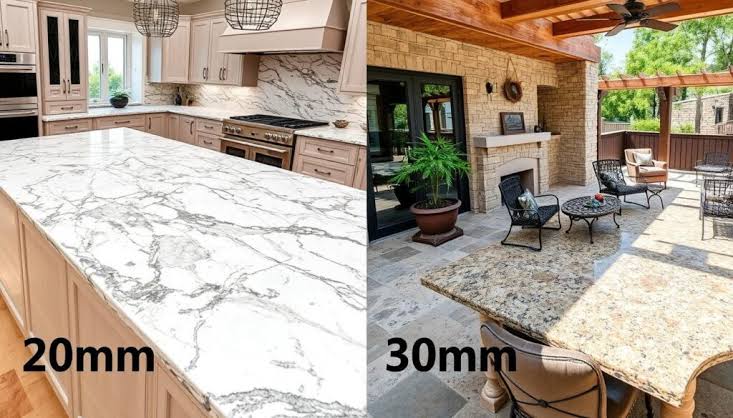
When planning a new kitchen, bathroom, bar, or commercial workspace, most buyers focus on choosing between marble, granite, quartz, or quartzite. However, another decision can have just as much impact on appearance, durability, installation requirements, and cost: countertop thickness.
The debate over 20mm vs 30mm countertops in Kenya is not simply about selecting a thicker slab. Thickness affects structural strength, edge profiles, fabrication methods, weight, installation complexity, and the overall visual impact of the finished countertop.
Recommended Stone Solutions



Both 20mm and 30mm slabs are widely used in residential and commercial projects across Kenya. Each has advantages depending on the material selected, cabinet design, intended use, and budget. In some cases, a well-supported 20mm countertop performs just as effectively as a 30mm slab. In others, the extra thickness offers practical and aesthetic benefits that justify the additional investment.
At Maruti Mining Limited, we help homeowners, architects, interior designers, and contractors compare thickness options so they can choose the most suitable solution for every project.
Explore premium natural stone and engineered quartz collections from Maruti Mining Limited at marutimining.
Why Does Countertop Thickness Matter?
Choosing between 20mm vs 30mm countertops in Kenya affects much more than appearance. Thickness influences strength, weight, fabrication, installation, and overall project cost.
Many buyers assume that thicker always means better.
In reality, the correct thickness depends on:
- Countertop material
- Cabinet support
- Span length
- Edge profile
- Application
- Budget
A professional assessment ensures the chosen thickness performs safely while achieving the desired design.
Understanding 20mm Countertops
A 20mm countertop measures approximately 2 centimetres thick and is one of the most common options for engineered quartz and many natural stone applications.
Its popularity comes from its balance of durability, practicality, and modern aesthetics.
Advantages of 20mm Countertops
A 20mm slab offers:
- Contemporary slim appearance
- Reduced overall weight
- Easier handling during installation
- Lower material consumption
- Greater design flexibility
This thickness is particularly suited to minimalist and modern interiors where clean lines are preferred.
Common Applications for 20mm Countertops
Twenty-millimetre slabs are frequently used for:
- Kitchen countertops
- Bathroom vanity tops
- Reception counters
- Utility rooms
- Commercial worktops
- Café counters
With proper support and professional fabrication, they perform well in most residential environments.
Understanding 30mm Countertops
A 30mm countertop measures approximately 3 centimetres thick and creates a noticeably heavier visual profile.
The extra thickness often conveys a premium, luxurious appearance while increasing the structural mass of the slab.
Advantages of 30mm Countertops
Thirty-millimetre slabs provide:
- Bold architectural appearance
- Increased rigidity
- Greater resistance to flexing
- Deeper edge profiles
- Premium visual impact
Many luxury homes and commercial developments favour this thickness because of its substantial look.
Common Applications for 30mm Countertops
Thirty-millimetre countertops are commonly selected for:
- Luxury kitchens
- Large islands
- Executive offices
- Hotel reception counters
- Restaurant bars
- Commercial installations
Their thicker profile often complements larger spaces and more dramatic interior designs.
20mm vs 30mm Countertops in Kenya: Appearance Comparison
Appearance is often the first reason buyers choose one thickness over the other.
While both can produce beautiful finished surfaces, they create different design impressions.
20mm Appearance
Twenty-millimetre countertops create:
- Sleek lines
- Modern styling
- Minimalist aesthetics
- Contemporary interiors
They pair particularly well with:
- Flat-panel cabinetry
- Handleless kitchens
- Scandinavian interiors
- Modern apartments
30mm Appearance
Thirty-millimetre slabs provide:
- Greater visual depth
- More substantial edge profiles
- Traditional luxury appearance
- Strong architectural presence
They work especially well with:
- Large kitchen islands
- Classic cabinetry
- Premium residences
- High-end commercial interiors
Does a Thicker Countertop Mean Greater Strength?
Not necessarily. Strength depends on the material, support structure, fabrication quality, and installation—not thickness alone.
For example:
- A properly supported 20mm quartz countertop can perform exceptionally well.
- A poorly installed 30mm granite slab may still crack if cabinets are uneven or unsupported.
Important factors include:
- Cabinet alignment
- Span length
- Cutout placement
- Overhang support
- Installation quality
Thickness improves rigidity, but correct engineering remains essential.
Weight Differences Between 20mm and 30mm Countertops
A thicker slab naturally weighs more.
The increased weight influences:
- Transportation
- Handling
- Installation
- Cabinet requirements
Professional installers evaluate whether cabinetry and supporting structures are suitable for the selected thickness before installation begins.
Which Thickness Costs More?
Generally, 30mm countertops cost more than 20mm countertops because they require more raw material and may involve higher transportation and installation costs.
However, total project pricing depends on several factors, including:
- Stone type
- Slab size
- Edge profile
- Cutouts
- Fabrication complexity
- Delivery
- Installation
Comparing complete quotations rather than material prices alone provides a more accurate picture of overall project costs.
Is 20mm Thick Enough for a Kitchen?
In most residential kitchens, 20mm countertops in Kenya provide excellent performance when professionally fabricated and correctly supported.
They are widely used for:
- Quartz worktops
- Granite countertops
- Marble vanity tops
- Kitchen islands with adequate support
Professional fabrication ensures that sink cut-outs, hob openings, and unsupported sections are properly reinforced where necessary.
Is 30mm Worth the Extra Cost?
For many projects, the additional investment in a 30mm countertop is justified by its appearance rather than by a dramatic increase in everyday performance.
If your goal is a bold, premium-looking kitchen, the thicker profile can make a significant visual difference.
However, many homeowners discover that a professionally installed 20mm countertop delivers the durability they need at a lower overall cost.
The decision should be based on:
- Design style
- Budget
- Cabinet construction
- Countertop material
- Intended use
20mm vs 30mm Countertops in Kenya for Quartz
Engineered quartz is one of the most common materials available in both 20mm and 30mm thicknesses.
20mm Quartz
Twenty-millimetre quartz is ideal for:
- Modern kitchens
- Bathroom vanities
- Apartments
- Office kitchens
- Contemporary homes
Advantages include:
- Elegant slim profile
- Lower weight
- Reduced installation costs
- Wide design selection
Because quartz has excellent structural strength, 20mm slabs perform well when properly supported.
30mm Quartz
Thirty-millimetre quartz is often selected for:
- Luxury homes
- Large kitchen islands
- Executive boardrooms
- Premium commercial projects
Benefits include:
- More substantial appearance
- Deeper edge profile
- Greater visual impact
Although stronger in terms of rigidity, the performance difference in everyday residential use is often less significant than buyers expect.
20mm vs 30mm Countertops in Kenya for Granite
Granite is naturally dense and durable, making both thicknesses suitable depending on the application.
20mm Granite
Suitable for:
- Kitchen countertops
- Bathroom vanities
- Utility rooms
- Residential projects
With professional installation, 20mm granite provides excellent long-term performance.
30mm Granite
Often chosen for:
- Large luxury kitchens
- Outdoor kitchens
- Commercial counters
- Feature islands
The thicker slab enhances the natural depth and character of granite while providing a more substantial edge.
Countertop Overhangs and Thickness
Countertop overhangs influence the choice between 20mm vs 30mm countertops in Kenya.
Long unsupported overhangs place additional stress on the stone.
Factors affecting overhang design include:
- Stone type
- Thickness
- Support brackets
- Cabinet construction
- Intended loading
Where significant overhangs are required, additional reinforcement may be specified regardless of slab thickness.
Edge Profiles: Does Thickness Make a Difference?
Yes.
The edge profile often determines how dramatic a countertop appears.
20mm Countertops
Popular edge options include:
- Pencil edge
- Eased edge
- Small bevel
- Straight polished edge
These create a clean contemporary appearance.
30mm Countertops
The extra thickness allows more prominent edge treatments such as:
- Deep bevels
- Ogee edges
- Bullnose profiles
- Decorative architectural edges
This is one reason luxury projects often favour thicker slabs.
Can a 20mm Countertop Look Like 30mm?
Yes.
One of the most popular fabrication techniques is the mitred edge.
A mitred edge joins two pieces of 20mm stone at approximately 45 degrees to create the appearance of a much thicker countertop.
Benefits include:
- Premium appearance
- Reduced slab weight
- Lower material consumption
- Modern seamless look
Many contemporary kitchens use mitred edges to achieve a 40mm or thicker visual profile without using a full-thickness slab.
Which Thickness Is Better for Kitchen Islands?
Kitchen islands often become the visual centrepiece of the home.
For this reason:
Choose 20mm if you prefer:
- Modern minimalist design
- Clean lines
- Slim contemporary styling
Choose 30mm if you prefer:
- Bold luxury appearance
- Traditional elegance
- Strong architectural presence
Both thicknesses perform well when correctly fabricated and supported.
Does Thickness Affect Installation?
Yes.
A thicker slab generally requires:
- More handling equipment
- Additional labour
- Stronger cabinetry
- More careful transportation
Professional installers evaluate:
- Access routes
- Staircases
- Lift capacity
- Cabinet strength
- Site conditions
before installation begins.
Common Mistakes When Choosing Countertop Thickness
Many buyers focus only on appearance and overlook technical requirements.
Avoid these common mistakes:
Choosing Thickness Before Selecting Material
Granite, quartz, marble, and quartzite all behave differently.
Material selection should come first.
Ignoring Cabinet Strength
Cabinets must adequately support the chosen countertop.
Poor support can lead to:
- Cracking
- Flexing
- Joint failure
Comparing Thickness Without Comparing Fabrication
High-quality fabrication is often more important than the additional 10mm of slab thickness.
Professional fabrication improves:
- Seam quality
- Edge finishing
- Structural integrity
- Overall appearance
Assuming Thicker Always Means Better
A thicker countertop is not automatically stronger, longer-lasting, or better value.
The best choice depends on the complete design and installation.
How to Decide Between 20mm and 30mm Countertops
Ask yourself:
Do you prefer modern or traditional styling?
- Modern → 20mm
- Traditional or luxury → 30mm
What is your budget?
A 20mm slab often reduces material and installation costs.
Is the countertop heavily loaded?
Large islands or long unsupported spans may influence the recommended thickness.
What edge profile do you want?
Some decorative profiles work better with thicker slabs.
Clients can also explore engineered quartz surfaces at quartz-stone, view premium marble collections at marble-manufacturer-kenya, discover granite options at top-granite-manufacturer-kenya-maruti-mining, or browse completed stone installations at our-works.


Leave a Reply