



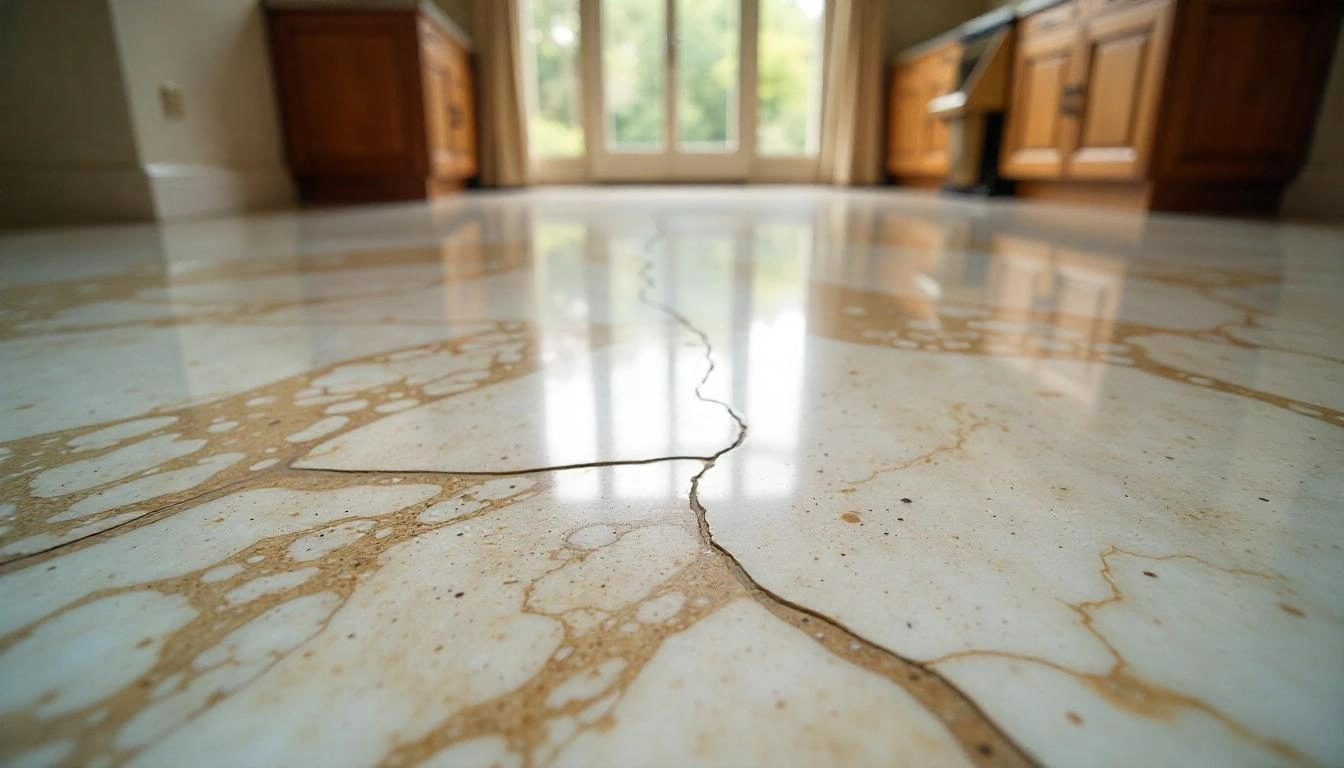
Worn marble floors in Kenya can look tired, scratched, dull or heavily used while the underlying stone remains perfectly capable of serving for many more years. The critical question is therefore not simply whether an old marble floor looks unattractive, but whether the deterioration is limited to the surface or indicates a deeper problem with the stone, installation or supporting structure.
This distinction matters because marble restoration and marble replacement are very different decisions.
Recommended Stone Solutions



A floor with surface dullness may require professional honing and polishing.
A floor covered with light scratches may be restored.
Etched areas may be refinished.
Stains may sometimes be treated.
But a marble tile that is badly cracked, loose, unstable or affected by underlying movement may require a different intervention.
Replacing an otherwise sound marble floor simply because its surface has lost its original shine can be an unnecessary expense.
Conversely, polishing a floor with serious structural or installation problems can hide the symptoms without addressing the cause.
The first step is therefore diagnosis.
Marble is a natural stone, and its appearance changes according to use, traffic, cleaning practices, surface finish, exposure and maintenance. A well-used floor may look very different from the day it was installed without necessarily having reached the end of its service life.
For architects, developers, homeowners, hotels and commercial property managers, understanding this distinction can make restoration decisions considerably more rational.
Maruti Mining Limited works with natural stone solutions for architectural applications, and you can visit our Knowledge Base for expert stone insights when evaluating stone selection, installation and maintenance.
Why Worn Marble Does Not Automatically Mean Damaged Marble
A worn-looking marble floor may still be structurally sound because many common signs of deterioration affect the surface finish rather than the body of the stone or the supporting installation.
This is perhaps the most important distinction to understand.
Marble can lose its visual appeal long before the material becomes unusable.
A polished floor may become dull.
Traffic lanes may become visible.
Fine scratches may accumulate.
Etched areas may appear cloudy.
The surface may lose its reflection.
These are significant maintenance issues, but they do not necessarily mean that the marble itself has failed.
Think of the floor in layers.
There is the visible finish.
Then there is the marble body.
Below that is the adhesive or bedding system.
Below the installation is the substrate.
A problem at one level does not automatically mean that every layer is defective.
This is why an assessment should begin with the visible symptom and work downward.
The Difference Between Surface Wear and Structural Damage
Surface wear affects the appearance or uppermost finish of the marble, while structural or installation-related problems can affect the stone’s stability, integrity or ability to remain securely installed.
Surface problems may include:
- Dullness
- Fine scratches
- Etching
- Light staining
- Loss of polish
- Traffic wear
- Minor surface marks
More serious problems may include:
- Full-depth cracks
- Broken tiles
- Loose tiles
- Significant movement
- Severe lippage
- Hollow areas associated with installation failure
- Water-related substrate problems
- Repeated cracking caused by movement
The distinction is critical.
A dull floor may need polishing.
A loose floor may need removal and reinstallation.
A cracked tile may need replacement.
A surface treatment cannot solve every underlying problem.
Check 1: Is the Marble Merely Dull?
Dullness is often a surface-finish issue rather than evidence that the marble itself has become unsound.
This is particularly common on polished marble floors in busy buildings.
Foot traffic gradually changes the surface.
Entrance areas may become less reflective.
Corridors may develop visible traffic paths.
Furniture movement can create localised wear.
The stone may still be intact underneath.
A dull appearance can result from:
- Abrasion
- Incorrect cleaning
- Detergent residue
- Etching
- Traffic
- Inadequate maintenance
- Loss of surface polish
The appropriate response is diagnosis rather than immediate replacement.
Why Polishing Can Restore a Worn Appearance
Where deterioration is primarily confined to the surface, professional honing or polishing may restore much of the marble’s original visual character without replacing the tiles.
The restoration process depends on the condition.
A professional may determine that the floor needs:
- Cleaning
- Honing
- Polishing
- Grinding
- Stain treatment
- Sealing where appropriate
Not every worn floor requires all of these.
A mildly dull floor may require considerably less intervention than one with deep scratches and widespread unevenness.
The key is to match the treatment to the condition.
Check 2: Are the Marks Scratches or Etching?
Scratches are physical surface marks, while etching is a chemical alteration of the surface, and distinguishing between the two helps determine the appropriate restoration method.
This difference is often misunderstood.
A scratch is caused by physical contact or abrasion.
For example:
- Grit under shoes
- Furniture movement
- Hard objects
- Abrasive cleaning tools
Etching is caused by chemical reaction.
Common causes include acidic substances such as:
- Lemon
- Vinegar
- Certain acidic cleaners
- Some food and drink residues
An etched area may look like a dull or cloudy patch.
It may not feel like a conventional scratch.
The treatment is different.
How Etching Makes Marble Look Old
Etching can make relatively new marble appear prematurely worn because the surface loses some of its reflective quality even when the stone body remains intact.
This can be particularly obvious on dark or highly polished marble.
Light catches the polished surface differently from the etched area.
The result can look like a faded patch.
A property owner may conclude that the marble is permanently damaged.
In many cases, however, the affected area can be professionally refinished.
That does not mean every etch is easily removable.
The depth and extent of the damage matter.
But the presence of etching alone does not justify replacing the entire floor.
Check 3: How Deep Are the Scratches?
Fine surface scratches may often be addressed through professional refinishing, while deep cracks or fractures require a more careful assessment of the stone’s structural condition.
Look at the scratches under strong lighting.
Are they:
- Fine and numerous?
- Deep and isolated?
- Concentrated in traffic routes?
- Limited to the surface?
- Associated with cracking?
Fine abrasion is common on heavily used marble.
Deep fractures are different.
A professional assessment should determine whether the damage is only superficial or extends into the body of the stone.
Why Traffic Lanes Matter
Visible traffic lanes can indicate repeated surface abrasion rather than failure of the marble itself, especially when the stone remains firmly installed and free from major cracking.
Consider a hotel corridor.
Thousands of people may walk through the same route.
The centre of the corridor may become duller than the edges.
This creates a visible wear pattern.
It is evidence of use.
It is not automatically evidence of structural failure.
The appropriate restoration method may be designed around the affected surface.
Check 4: Are There Cracks?
Cracks deserve more attention than ordinary dullness because their location, width, pattern and depth can indicate whether the problem is isolated to a tile or related to movement beneath the floor.
Not every crack means the entire floor is failing.
A single cracked tile can result from:
- Impact
- Local stress
- Installation issues
- Material variation
But repeated cracks across multiple tiles may indicate a wider problem.
Pay attention to patterns.
Are cracks:
- Repeating along a straight line?
- Appearing across several tiles?
- Concentrated near structural joints?
- Reappearing after replacement?
Repeated cracking may warrant investigation beyond the marble surface.
Why Cracks Should Not Simply Be Polished
Polishing can improve the appearance of a surface but cannot correct an underlying structural crack or substrate movement.
This is where proper diagnosis matters.
If a crack is caused by movement beneath the stone, polishing will not solve the cause.
The floor may look better temporarily while the underlying problem remains.
Eventually the crack may return.
A restoration plan should therefore distinguish cosmetic restoration from corrective repair.
Check 5: Are the Tiles Loose?
A loose marble tile is fundamentally different from a dull marble tile because movement indicates a possible installation or substrate issue rather than simple surface wear.
Signs can include:
- Movement when stepped on
- Gaps around the tile
- Cracked grout
- Repeated grout failure
- A hollow sound during appropriate inspection
- Visible lifting
A loose tile should not simply be polished.
It may require removal and assessment of the bedding or adhesive.
Hollow-Sounding Marble
A hollow sound during a professional assessment can indicate insufficient contact beneath a tile, but the sound alone should not be treated as proof that a tile has failed.
This is important because natural stone installations can produce different acoustic responses.
A professional should consider:
- Tile size
- Installation method
- Adhesive coverage
- Substrate condition
- Location
- Movement
- Visible cracking
The assessment should combine multiple indicators.
Do not condemn an entire floor based on one test alone.
Check 6: Is There Lippage?
Lippage refers to a difference in height between adjacent tiles, and significant lippage can affect both appearance and usability even when the marble itself remains intact.
A floor may have beautifully polished marble but still feel uneven.
This can result from:
- Installation tolerances
- Substrate irregularities
- Tile thickness variation
- Movement
- Poor installation technique
Minor variations may be acceptable depending on the installation.
Significant lippage may require corrective work.
The appropriate solution depends on the extent and cause.
Why Lippage Is Different from Surface Wear
Polishing can improve the surface of marble, but excessive height differences between tiles may require a more substantial restoration or reinstallation approach.
If one tile is visibly higher than another, surface polishing alone may not solve the problem.
In some cases, professional grinding and levelling may be possible.
In other cases, tiles may need to be removed and reinstalled.
The condition of the substrate is critical.
Check 7: Is the Grout Failing?
Deteriorating grout can make an otherwise sound marble floor appear neglected and may also allow moisture or dirt to accumulate around tile joints.
Inspect the grout for:
- Cracks
- Missing sections
- Discolouration
- Powdering
- Gaps
- Persistent dampness
Grout problems do not necessarily mean that the marble is defective.
The grout can be repaired separately if the underlying installation remains sound.
However, repeated grout failure should be investigated.
It may be a symptom of movement.
Water and Moisture Problems
Persistent moisture can affect both the appearance and long-term performance of a stone installation, so unexplained dampness should be investigated rather than concealed with surface treatments.
Potential warning signs include:
- Dark patches
- Persistent damp areas
- Salt deposits
- Staining
- Mould around joints
- Repeated grout deterioration
Moisture can come from:
- Plumbing
- Cleaning practices
- Poor drainage
- Ground moisture
- Leaks
- Building-envelope problems
Polishing the floor does not resolve the source.
The underlying moisture issue must be identified.
Salt Deposits and Efflorescence
White powdery deposits around joints or surfaces may sometimes indicate moisture movement and should not automatically be treated as ordinary dirt.
Such deposits can occur when dissolved materials move with moisture and later crystallise at or near the surface.
The correct response depends on the building system.
If deposits repeatedly return after cleaning, investigate the source of moisture.
This is especially important in older buildings.
Staining Does Not Always Mean Replacement
Many stains affect the appearance of marble without making the stone structurally unsound, so persistent staining should be assessed before deciding that the floor has reached the end of its life.
Different stains require different approaches.
Examples include:
- Oil
- Organic stains
- Rust
- Water-related marks
- Cleaning-product residues
The treatment should be selected based on the contaminant and marble type.
Aggressive experimentation can create additional damage.
Why Old Marble Can Still Be Valuable
Age alone does not make marble unsuitable; a properly installed and structurally sound marble floor can remain a valuable architectural feature long after its original polish has disappeared.
Some older marble floors have:
- Thick stone sections
- Durable installation
- High-quality material
- Attractive natural variation
- Architectural character
Replacing them may remove an asset that could have been restored.
This is why restoration assessment is important.
Restoration Versus Replacement
The decision to restore or replace should be based on the condition of the stone, installation and substrate rather than simply on how old or unattractive the floor appears.
Restoration may make sense when:
- The stone remains intact.
- Cracks are limited.
- Tiles remain secure.
- Surface wear is the main problem.
- Lippage is manageable.
- Staining is treatable.
Replacement may become more appropriate when:
- Large areas are structurally compromised.
- Tiles repeatedly fail.
- Severe substrate movement exists.
- Major cracking continues.
- The original stone is unavailable and repairs would be visually unacceptable.
- Restoration costs approach or exceed replacement value.
The decision should be based on evidence.
Why Restoration Can Be More Sustainable
Restoring a sound marble floor can preserve existing material and reduce the need to remove, transport and replace large quantities of stone.
Where technically appropriate, restoration can also reduce disruption.
A building may continue operating while sections are restored.
This can be particularly valuable in:
- Hotels
- Offices
- Retail spaces
- Residential developments
- Heritage buildings
The actual feasibility depends on the condition and scope.
Grinding, Honing and Polishing
Different marble restoration processes address different levels of surface deterioration, so they should not be treated as interchangeable services.
Grinding
Grinding can address deeper surface irregularities and help correct certain levels of damage.
Honing
Honing creates a smoother, lower-sheen surface and can address scratches and surface imperfections.
Polishing
Polishing restores a higher-reflective finish where the stone and condition are suitable.
The process may involve more than one stage.
A professional assessment should determine the appropriate sequence.
Why More Polish Is Not Always Better
A highly reflective finish is not necessarily the best finish for every marble floor because traffic, slip considerations, maintenance requirements and architectural intent should also influence the decision.
A busy commercial floor may benefit from a finish that is easier to maintain visually.
A residential entrance may have different priorities.
A heritage building may need to preserve its existing character.
The desired finish should therefore be agreed before restoration begins.
Cleaning Before Restoration
A professional assessment should distinguish surface contamination from actual stone deterioration because dirt, wax, residue and unsuitable cleaning products can make a sound floor appear worse than it is.
For example, a floor may appear dull because of:
- Wax buildup
- Detergent residue
- Dust
- Oil
- Construction residue
These problems may not require grinding or polishing.
Cleaning and assessment should come first where appropriate.
Why Wax Can Confuse the Assessment
Improper wax or coating buildup can alter the appearance of marble and create a surface film that hides the actual condition of the stone.
A coated floor can look:
- Cloudy
- Uneven
- Artificially glossy
- Sticky
Removing the coating may reveal that the underlying marble is in better condition than expected.
This is another reason diagnosis matters.
Marble in High-Traffic Kenyan Properties
High foot traffic, dust and grit can accelerate surface wear, particularly in entrances, corridors and public spaces, but these conditions do not automatically mean the marble needs replacement.
A hotel lobby can experience continuous traffic.
An office building can have concentrated wear near reception.
A shopping centre can experience extreme entrance abrasion.
The correct response is often a combination of:
- Better entrance matting
- Grit control
- Routine cleaning
- Furniture protection
- Periodic professional restoration
A maintenance programme can significantly extend the useful life of the stone.
The Role of Entrance Matting
Entrance matting reduces the amount of abrasive grit reaching marble floors and should be considered part of the long-term protection strategy in high-traffic properties.
A well-designed entrance system can reduce:
- Dust
- Sand
- Soil
- Moisture
This is particularly useful where outdoor surfaces connect directly to polished interiors.
A small decorative mat may not provide sufficient protection.
The mat should be large enough and maintained properly.
Furniture Protection on Marble Floors
Felt pads and appropriate furniture protection can reduce scratching caused by repeated movement of chairs, tables and other furniture across polished marble.
Inspect protective pads regularly.
Replace them when:
- They become thin.
- They detach.
- They collect grit.
- They stop covering the contact point.
The cost of replacing a felt pad is minimal compared with restoring an entire floor.
Why Incorrect Cleaning Can Accelerate Wear
Some worn marble floors are made worse by the cleaning process itself, particularly when abrasive tools, acidic chemicals or excessive scrubbing are used repeatedly.
A cleaning routine should therefore be reviewed when a floor deteriorates unexpectedly.
Ask:
- What products are being used?
- How frequently?
- At what concentration?
- Which mop or machine is being used?
- Are abrasive pads involved?
- Is grit removed before wet cleaning?
Maintenance history can reveal the cause.
The Effect of Acidic Cleaners
Repeated exposure to acidic cleaners can gradually affect acid-sensitive marble surfaces, producing dull or etched areas that may be mistaken for ordinary wear.
This is why natural stone should not be maintained using generic cleaning routines without checking compatibility.
Products marketed as:
- Descalers
- Bathroom cleaners
- Limescale removers
- Tile cleaners
may require particular caution.
The label should be reviewed carefully.
Assessing Marble Countertops Versus Floors
The same marble can behave differently in a countertop and flooring application because the type and frequency of exposure are different.
Floors experience:
- Foot traffic
- Grit
- Furniture
- Cleaning equipment
Countertops experience:
- Food
- Oils
- Acidic ingredients
- Heat
- Cutting activities
The assessment should therefore consider the application.
A surface that is appropriate for a decorative wall may not be appropriate for a busy floor.
Checking the Stone Thickness
The remaining thickness and condition of the marble can influence whether certain restoration techniques are appropriate, especially when significant grinding or levelling is being considered.
This is particularly important for older installations.
Repeated restoration over many years can alter the surface.
Before aggressive material removal, the restoration specialist should consider the remaining stone and the intended result.
Restoration should preserve as much sound material as practical.
What a Professional Marble Assessment Should Examine
A useful assessment should look beyond appearance and evaluate the stone, surface, joints, installation and surrounding conditions together.
A professional review may consider:
- Surface finish
- Scratches
- Etching
- Cracks
- Chips
- Lippage
- Loose tiles
- Grout condition
- Moisture
- Staining
- Traffic patterns
- Previous restoration
- Cleaning practices
This provides a much better basis for deciding between restoration and replacement.
When a Single Tile Should Be Replaced
A damaged individual tile does not necessarily justify replacing an entire floor if matching material can be sourced and the surrounding installation remains sound.
Replacement may be appropriate for:
- A badly broken tile
- Severe local damage
- Irreversible staining
- Major chips
However, matching older marble can be difficult.
Natural stone varies naturally in colour, veining and mineral structure.
A replacement tile may therefore be structurally appropriate but visually different.
This should be considered before removal.
Why Matching Old Marble Can Be Difficult
Natural stone has natural variation, so a new marble tile may not perfectly match an older floor even when the stone type is nominally the same.
Differences can occur in:
- Veining
- Colour
- Grain
- Mineral content
- Finish
- Age-related patina
For this reason, restoration may sometimes provide a more visually consistent result than replacing selected areas.
What About Chips and Edge Damage?
Small chips may sometimes be repaired or blended depending on their size and location, while major edge failures may require tile replacement or more substantial restoration.
Chips commonly occur at:
- Doorways
- Stair edges
- Corners
- Furniture contact points
The treatment depends on severity.
Minor damage may be repairable.
Major breakage requires closer assessment.
Marble Stairs Require Special Attention
Worn marble stairs deserve careful inspection because tread edges, nosings and repeated foot traffic can experience concentrated wear that differs from a flat floor.
Check for:
- Rounded edges
- Chips
- Cracks
- Uneven treads
- Slippery or excessively polished areas
- Loose sections
Restoration should also consider safe use.
The objective is not simply to maximise shine.
Safety and Marble Restoration
Marble restoration should balance appearance with safe use, particularly on stairs, entrances and areas exposed to moisture.
A mirror-like finish may not be appropriate in every application.
The chosen finish should consider:
- Foot traffic
- Moisture
- Slope
- Stair configuration
- Maintenance
- Building use
A professional should discuss the intended result before work begins.
Marble Floors in Commercial Buildings
Commercial properties should treat marble restoration as both a maintenance and asset-management decision because floor condition can influence appearance, visitor perception and operational costs.
A neglected lobby can affect the perceived quality of a building.
At the same time, replacing a large marble floor can be expensive and disruptive.
Restoration may provide a practical middle path where the stone remains sound.
Regular maintenance can then reduce the rate of deterioration.
Hotels and Hospitality Spaces
Hotels often benefit from planned marble maintenance because entrances, lobbies and corridors experience repeated traffic and need to maintain a consistently presentable appearance.
Rather than waiting for the floor to become severely worn, management can schedule periodic inspection and restoration.
This can help prevent the need for major emergency work.
Residential Marble Floors
Residential marble floors may require less frequent professional restoration than commercial floors, but cleaning habits and furniture movement can still create preventable damage.
Homeowners should pay particular attention to:
- Entrances
- Kitchens
- Dining areas
- Corridors
- Furniture feet
- Spill-prone areas
Small preventive measures can extend the visual life of the floor.
The Cost of Restoration Versus Replacement
Cost should be considered after the condition has been assessed because restoration can be more economical when the existing marble and installation remain fundamentally sound.
A comparison should include:
Restoration costs
- Cleaning
- Grinding
- Honing
- Polishing
- Repairs
- Sealing
Replacement costs
- New marble
- Removal
- Disposal
- Substrate preparation
- Installation
- Labour
- Finishing
- Downtime
The cheapest option on paper may not always be the best long-term option.
Why You Should Not Judge Marble by Shine Alone
Shine is only one indicator of surface condition and does not tell you whether the stone is cracked, loose, unstable or structurally sound.
A highly polished floor can still have serious installation problems.
A dull floor can still be structurally excellent.
This is why visual appearance must be combined with physical assessment.
A Practical Seven-Point Marble Floor Assessment
Before deciding to replace a worn marble floor, evaluate seven key areas: surface finish, scratches, cracks, tile stability, lippage, joints and moisture.
1. Surface finish
Is the marble simply dull?
2. Scratches
Are they fine surface marks or deep damage?
3. Cracks
Are cracks isolated or widespread?
4. Tile stability
Are tiles firmly installed?
5. Lippage
Are adjacent tiles reasonably level?
6. Grout
Are joints intact?
7. Moisture
Are there recurring dampness or staining issues?
If most of these areas are satisfactory, restoration may be worth investigating.
When Replacement Becomes More Reasonable
Replacement becomes more compelling when the underlying installation is repeatedly failing or when extensive structural damage makes restoration impractical.
Warning signs can include:
- Widespread cracking
- Repeated tile movement
- Severe substrate failure
- Major water problems
- Extensive broken areas
- Persistent movement-related damage
Even then, the cause should be identified before replacement.
Otherwise, the new floor may experience the same problem.
Fix the Cause, Not Just the Surface
A successful marble restoration addresses the reason for deterioration wherever possible rather than merely improving the appearance temporarily.
If grit is causing abrasion, improve entrance protection.
If furniture is scratching the floor, use appropriate pads.
If acidic cleaners are causing etching, change the cleaning system.
If moisture is causing recurring damage, investigate the source.
If substrate movement is causing cracking, address the installation problem.
This is the difference between maintenance and cosmetic concealment.
Preventing Future Marble Wear
Once a marble floor has been restored, preventive maintenance becomes essential to preserve the investment and delay another major restoration cycle.
A practical strategy includes:
- Entrance mats
- Routine dust removal
- Stone-safe cleaning products
- Prompt spill response
- Furniture felt pads
- Appropriate traffic management
- Periodic inspection
- Professional maintenance when necessary
The objective is to slow deterioration.
Why Restoration Should Be Planned
Planned restoration is generally easier to manage than waiting until the marble has suffered extensive deterioration.
A planned programme can:
- Reduce disruption
- Spread maintenance costs
- Identify problems early
- Preserve the finish
- Extend service life
For commercial properties, this can also make budgeting easier.
Choosing a Stone Specialist
Marble restoration should be entrusted to professionals who understand natural stone behaviour, surface finishes and the difference between cosmetic and structural problems.
Before work begins, ask for:
- Assessment
- Recommended process
- Expected finish
- Explanation of limitations
- Maintenance recommendations
- Clear scope of work
Do not select a contractor solely on the promise of making the floor “look new.”
The correct objective is to restore the stone appropriately for its condition and use.
For projects requiring new natural stone or professional stone solutions, explore our collection of completed projects and learn more about Maruti Mining’s natural stone solutions.
Final Guide to Worn Marble Floors in Kenya
A worn marble floor is not necessarily a failed marble floor. The most important question is whether the deterioration is confined to the surface or indicates a deeper problem with the stone, installation or substrate.
Dullness does not automatically mean replacement.
Fine scratches do not automatically mean structural failure.
Etching does not necessarily mean the marble is beyond restoration.
Staining does not automatically mean the stone must be removed.
But cracks, loose tiles, severe lippage, recurring movement and persistent moisture problems deserve closer investigation.
The right decision begins with diagnosis.
If the marble is fundamentally sound, professional cleaning, honing, polishing, grinding or local repair may restore its appearance and extend its service life.
If the underlying installation is failing, however, surface restoration alone will not solve the problem.
This is why property owners should resist the temptation to judge marble purely by appearance.
A floor can look tired while remaining a valuable and restorable asset.
Conversely, a floor can look attractive while hiding serious installation problems.
For Kenyan homeowners, developers, architects and facility managers, the most practical approach is to assess the floor systematically.
Look at the surface.
Check the scratches.
Investigate cracks.
Examine tile stability.
Assess lippage.
Inspect the grout.
Look for moisture.
Then determine whether the problem is cosmetic, maintenance-related, installation-related or structural.
This approach avoids two expensive mistakes.
The first is replacing sound marble unnecessarily.
The second is spending money polishing a floor whose underlying problems have not been addressed.
Natural stone has long service potential when it is correctly selected, installed and maintained.
Where the existing marble remains sound, restoration can often bring back much of the character that made the material attractive in the first place.
For architects, developers and homeowners considering marble for a new project, material selection should also account for the intended environment, traffic and maintenance requirements. You can explore our marble options when planning a new stone application.
And if an existing marble floor has become worn, dull or damaged, do not assume that replacement is the only answer.
First determine whether the stone is still sound.
That single assessment can make the difference between unnecessary replacement and a successful restoration that gives the floor many more years of useful service.
You May Also Like


Bring Your Vision to Life in Stone
Imagine a space defined by elegance, durability, and timeless beauty. At Maruti Mining Limited, we transform your vision into reality with the finest selection of granite, marble, and quartz, backed by expert fabrication and installation.
Contact our team for a consultation and let’s create a legacy set in stone.
CUSTOM FABRICATION & INSTALLATION ACROSS EAST AFRICA
✔ Premium Collection of Over 80 Stone Varieties
✔ Expert Cutting, Polishing & Installation
✔ Free Project Consultation & Quote
✔ Serving Kenya (Nairobi, Karen, Mombasa), Uganda, Tanzania & beyond.
Request Your Free Consultation:
Maruti Mining Limited
Email: [email protected]
Phone: +254 736 701 174 | +254 728 789 164 | +254 733 519 836
Visit Us: Nairobi, Kenya
Website: https://marutimining.com/


Leave a Reply