


Stone countertops are built to withstand decades of everyday use, but no surface is completely immune to damage. Heavy impacts, poor installation, inadequate support, excessive heat, or accidental misuse can all result in chips, cracks, stains, or other forms of deterioration. When countertop damage in Kenya occurs, many homeowners immediately assume the entire worktop must be replaced. Fortunately, that is not always the case.
Some types of damage are largely cosmetic and can often be repaired by experienced stone specialists. Small chips along an edge, minor scratches, or isolated surface imperfections may be restored without replacing the entire slab. On the other hand, structural cracks, large fractures, or damage around unsupported openings can compromise the integrity of the countertop and may require complete replacement.
Recommended Stone Solutions


Knowing the difference between repairable and non-repairable damage can save both time and money. Rather than making assumptions based on appearance alone, it is important to understand what caused the damage, how deep it extends, and whether the countertop remains structurally sound.
This guide explains the most common forms of countertop damage in Kenya, why they occur, which repairs are realistic, and when investing in a new slab becomes the safer and more economical option.
At Maruti Mining Limited, we help homeowners, architects, interior designers, contractors, and developers assess damaged stone surfaces and recommend practical repair or replacement solutions based on the condition of the countertop.
Explore premium engineered quartz, granite, marble, porcelain, and quartzite surfaces from Maruti Mining Limited at quartz-stone.
Understanding Countertop Damage
Not every crack or chip means the countertop has failed. Understanding the type of damage is the first step in deciding whether repair or replacement is appropriate.
Common forms of countertop damage include:
- Edge chips
- Hairline cracks
- Structural fractures
- Surface scratches
- Heat damage
- Stains
- Etching
- Joint separation
Each type has different causes and repair options.
What Causes Countertop Damage in Kenya?
Several factors contribute to countertop damage in Kenya, including installation quality, material selection, and everyday use.
The most common causes include:
- Heavy impacts from cookware
- Poor cabinet support
- Unsupported overhangs
- Incorrect sink or hob cut-outs
- Thermal shock
- Building movement
- Improper transportation
- Fabrication errors
Identifying the original cause helps prevent the same problem from recurring after repairs.
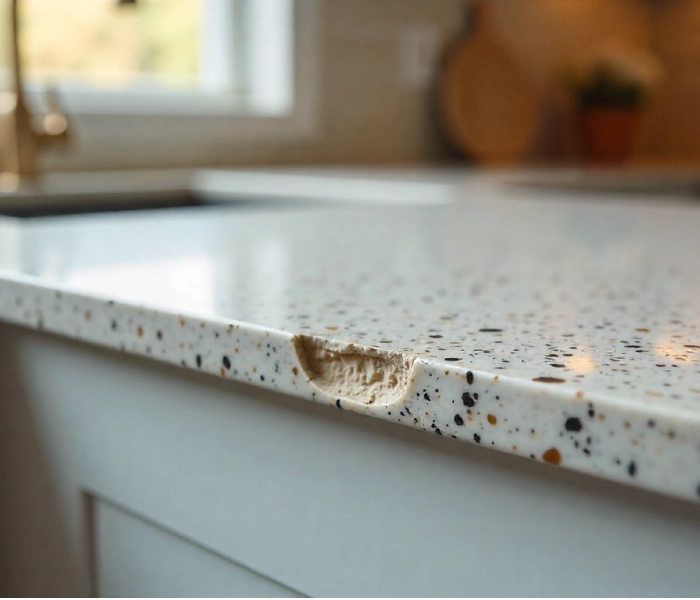
Minor Edge Chips
Small chips are among the most common forms of stone damage.
They often occur when:
- Heavy pots strike exposed edges
- Metal objects fall onto corners
- Appliances are moved carelessly
In many cases, small chips can be repaired using colour-matched stone repair compounds and careful polishing.
Hairline Cracks
Hairline cracks may appear alarming but are not always structural.
Possible causes include:
- Minor movement
- Installation stress
- Localised impacts
- Fabrication defects
A professional inspection determines whether the crack affects only the surface or extends through the slab.
Structural Cracks
Structural cracks differ significantly from cosmetic cracks.
They often extend through the full thickness of the countertop and may result from:
- Inadequate support
- Excessive overhangs
- Heavy loading
- Poor installation
- Major impacts
These cracks usually require more extensive repair or replacement.
Damage Around Sink and Hob Cut-Outs
Cut-outs are naturally weaker than solid sections of the countertop.
Damage may occur if:
- Corners are cut too sharply
- Support is insufficient
- Heavy objects are placed across openings
- Fabrication tolerances are incorrect
Professional fabrication significantly reduces these risks.
Surface Scratches
Quartz, granite, and quartzite are highly scratch resistant, while marble is generally more susceptible.
Minor scratches may result from:
- Abrasive cleaning pads
- Construction tools
- Dragging metal objects
- Repeated wear
Whether a scratch can be repaired depends on the stone type and finish.
Heat Damage
Excessive heat affects different materials in different ways.
For example:
- Quartz resins may scorch under extreme temperatures.
- Marble may experience thermal stress.
- Granite generally offers better heat resistance but is not immune to sudden temperature changes.
Using trivets remains the safest practice for all countertop materials.
Why Professional Assessment Matters
Visible damage does not always reveal the true condition of a countertop.
Stone specialists assess:
- Crack depth
- Structural integrity
- Support conditions
- Fabrication quality
- Repair feasibility
This prevents unnecessary replacements while ensuring unsafe countertops are identified.
Common Myths About Countertop Damage
Myth: Every crack means the slab must be replaced.
Reality: Many cracks are repairable depending on their location, depth, and cause.
Myth: Small chips always become large cracks.
Reality: Properly repaired chips often remain stable for many years.
Myth: DIY repair kits permanently solve every problem.
Reality: Cosmetic repairs may improve appearance, but structural damage requires professional evaluation.
For more expert stone care advice, visit the Maruti Mining Knowledge Base at knowledge-base.
Which Types of Countertop Damage Can Usually Be Repaired?
Not all countertop damage in Kenya requires replacing the entire slab. Many forms of cosmetic damage can be repaired successfully by experienced stone specialists, particularly when the countertop remains structurally sound.
Repair is often possible for:
- Small edge chips
- Minor corner damage
- Light surface scratches
- Small polish defects
- Slight joint imperfections
- Localised stains (depending on the material)
- Minor resin defects in engineered quartz
The success of any repair depends on the material, the extent of the damage, and the quality of the workmanship.
Small Edge Chips
Edge chips are among the easiest repairs.
Professional stone technicians can often:
- Clean the damaged area
- Apply colour-matched repair resin
- Shape the repaired section
- Polish the surface to blend with the original finish
While the repair may not become completely invisible, it is often difficult to notice during everyday use.
Surface Scratches
The repair process depends on the countertop material.
Quartz
Engineered quartz rarely develops deep scratches under normal household use.
Minor marks can sometimes be improved through professional cleaning or surface treatment, although deep scratches are less common.
Granite
Light scratches may sometimes be polished depending on the finish and depth.
Marble
Marble is softer than granite and quartz.
Professional honing and polishing can often restore scratched marble surfaces very effectively.
Joint Repairs
Modern countertops frequently contain joints where two slabs meet.
Over time, joint filler may:
- Shrink
- Discolour
- Separate slightly
In many cases, specialists can remove the old filler and replace it without replacing the countertop itself.
Stain Removal
Some stains can be removed depending on:
- Stone type
- Length of exposure
- Staining material
Examples include:
- Oil
- Coffee
- Wine
- Food colouring
Professional stain removal techniques often produce much better results than household cleaning products.
When Replacement Is Usually the Better Option
Some forms of countertop damage in Kenya affect the structural integrity of the slab and are far more difficult to repair safely.
Replacement is often recommended when:
- Cracks extend completely through the slab
- Multiple structural fractures exist
- Large sections have broken away
- The countertop has severe installation defects
- Damage repeatedly returns after repair
Safety should always take priority over appearance.
Structural Cracks Near Sink Cut-Outs
Sink openings naturally weaken stone countertops.
Cracks around these areas may continue to grow if:
- Heavy sinks remain unsupported
- Cabinets move
- The slab flexes during use
Depending on the severity, replacement may provide the safest long-term solution.
Damage from Poor Cabinet Support
Even premium stone can crack if the supporting cabinets are uneven.
Signs include:
- Cracks following cabinet joints
- Movement when pressure is applied
- Uneven countertop levels
- Doors becoming difficult to close
Before replacing the slab, the support structure should also be corrected.
Heat Damage That Cannot Be Reversed
Extreme heat may permanently affect some countertop materials.
For example:
- Quartz resin may scorch or discolour.
- Resin binders cannot usually be restored after severe burning.
- Localised replacement is rarely practical.
Preventing heat damage is far easier than repairing it.
Can a Broken Corner Be Repaired?
Sometimes.
Repair depends on:
- Size of the missing section
- Edge profile
- Stone colour
- Material type
- Location of the damage
Small corner losses may be rebuilt successfully, while major breakages often require slab replacement.
Should You Attempt DIY Repairs?
Many repair kits promise professional results.
However, DIY repairs often struggle to match:
- Colour
- Polish
- Texture
- Structural strength
Poor repairs can make later professional restoration more difficult.
Professional assessment is usually the safest option before attempting any repair.
Preventing Future Countertop Damage
The best repair is prevention.
Simple habits include:
- Avoid dropping heavy cookware.
- Use chopping boards.
- Use trivets beneath hot pans.
- Keep cabinets properly level.
- Avoid standing on countertops.
- Clean with suitable stone-safe products.
- Inspect joints periodically.
Routine care significantly extends countertop lifespan.
Why Professional Assessment Saves Money
Some homeowners replace countertops unnecessarily.
Others continue using damaged countertops that should be replaced.
A professional inspection helps determine:
- Whether repair is practical
- Estimated repair costs
- Expected repair lifespan
- Whether replacement offers better long-term value
This prevents unnecessary expense while ensuring the countertop remains safe.
Clients can also explore engineered quartz collections at quartz-stone, discover premium granite surfaces at top-granite-manufacturer-kenya-maruti-mining, view elegant marble collections at marble-manufacturer-kenya, or browse completed stone installations at our-works.


Leave a Reply